


Data Centre Cooling Explained: Airflow, Containment and Liquid Cooling
.svg)
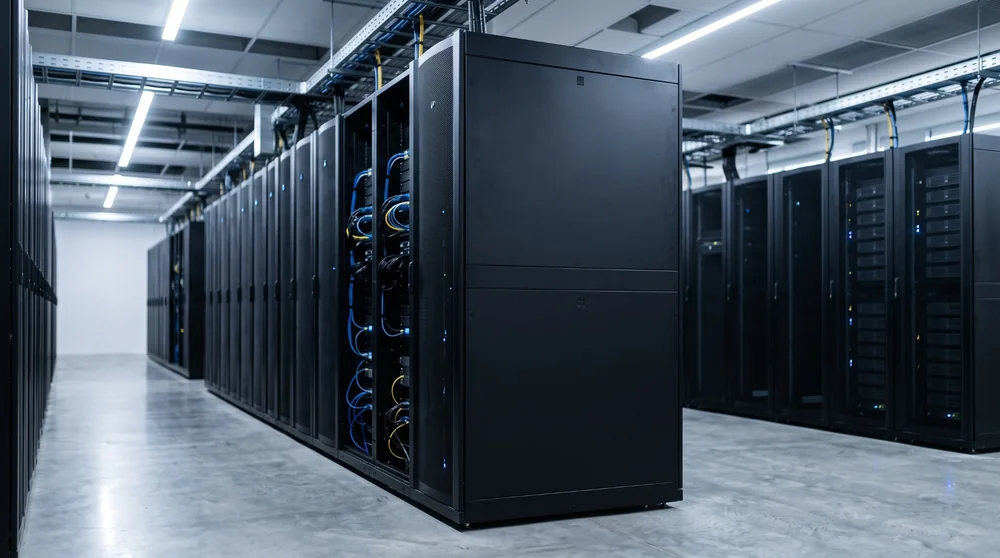
Data centre cooling removes the heat produced by servers, storage, networking and other electrical equipment so that IT systems remain within suitable operating conditions. Cooling is one of the largest facility responsibilities in a data centre and has a major effect on reliability, energy efficiency, capacity and cost.
Traditional facilities rely heavily on controlled air movement. Higher-density AI and high-performance computing are increasing the use of liquid cooling because air becomes harder to use efficiently as rack heat loads rise.
Why do servers produce so much heat?
Almost all electrical power consumed by IT equipment ultimately becomes heat.
A rack drawing 20 kilowatts of IT power therefore introduces roughly the same order of heat load into the environment. As rack power increases, the cooling system must remove more heat from a smaller physical area.
If temperatures rise beyond acceptable operating ranges, equipment can:
- reduce performance
- increase fan speeds and power consumption
- shut down
- experience reduced reliability
What is the aim of data centre cooling?
The goal is not simply to make the room feel cold.
A well-designed cooling system aims to:
- deliver suitable conditions to IT equipment intakes
- remove heat efficiently
- avoid hot spots
- control airflow
- maintain appropriate humidity and environmental conditions
- support resilience during equipment failure or maintenance
- use energy and water responsibly
Overcooling a room can waste energy without improving IT reliability.
What is a hot aisle and cold aisle?
Most rack-mounted servers draw cool air through the front and exhaust heated air through the rear.
Data centres therefore arrange racks so that:
- rack fronts face each other, creating a cold aisle
- rack backs face each other, creating a hot aisle
This separates supply and exhaust airflow more effectively than placing racks in random orientations.
What is hot-aisle containment?
Hot-aisle containment encloses the hot exhaust aisle so that heated air is prevented from mixing freely with the cooler room air.
The hot air is directed back towards the cooling system, while the rest of the room can remain closer to the server inlet temperature.
What is cold-aisle containment?
Cold-aisle containment encloses the cold supply aisle.
Cool air is kept around the server fronts, while the surrounding room becomes the hot-air return space.
Both approaches can be effective. The preferred design depends on the cooling architecture, fire protection, ceiling height, room layout, rack density and operational requirements.
Why is airflow management important?
Cooling capacity can exist on paper while servers still overheat if air is allowed to take the wrong path.
Common airflow problems include:
- hot exhaust air recirculating to server inlets
- cool supply air bypassing the equipment
- open spaces in racks allowing air mixing
- poorly managed floor openings
- cables obstructing airflow
- uneven rack loading
Small changes such as blanking panels and sealing unnecessary openings can sometimes improve thermal performance significantly.
What are blanking panels?
Blanking panels fill unused rack-unit spaces.
Without them, hot exhaust air can circulate through empty rack openings and reach equipment intakes. Using blanking panels helps maintain front-to-back airflow through the intended equipment path.
What is raised-floor cooling?
Many traditional data centres use a raised floor as an underfloor air-supply plenum.
Cooling units supply conditioned air below the floor. Perforated tiles or grilles then deliver air to cold aisles.
Raised floors can also provide pathways for some cabling and services, although modern facilities may use slab-floor designs with overhead cabling and other air-distribution approaches.
What is a CRAC unit?
CRAC stands for Computer Room Air Conditioner.
The term is commonly associated with computer-room cooling units that use a direct-expansion refrigeration cycle, though it is sometimes used loosely to describe data centre air-conditioning units more generally.
The unit circulates room air, removes heat and returns conditioned air to the IT space.
What is a CRAH unit?
CRAH stands for Computer Room Air Handler.
A CRAH commonly uses chilled water supplied from a central plant. Fans move data centre air across a cooling coil containing chilled water, transferring heat away from the room.
Large facilities may use chillers, pumps and cooling towers or other heat-rejection systems as part of the wider mechanical plant.
CRAC vs CRAH
| CRAC | CRAH |
|---|---|
| Often uses direct-expansion refrigerant cooling | Often uses chilled water from central plant |
| Can suit smaller or distributed cooling designs | Common in larger chilled-water facilities |
| Includes refrigeration components associated with the unit/system | Relies on external chilled-water production |
Real product terminology varies, so operators should use the equipment manufacturer's documentation rather than rely only on acronyms.
What is free cooling or economisation?
Economisation uses favourable outdoor conditions to reduce the amount of mechanical refrigeration required.
Depending on the design, this can involve:
- using filtered outside air directly
- using outdoor air indirectly through heat exchangers
- using lower outdoor temperatures to cool water
Climate has a major influence on how much economisation is possible.
What is evaporative cooling?
Evaporative cooling uses the evaporation of water to reduce air temperature.
It can improve energy efficiency in suitable climates, but water use becomes an important environmental consideration.
This is one reason data centre sustainability cannot be measured through electricity use alone.
Why is humidity controlled?
Very dry conditions can increase electrostatic-discharge risk, while excessive moisture can create other environmental problems.
Modern data centre guidance allows broader environmental ranges than many older facilities historically used, but operators should follow current equipment and industry guidance rather than relying on outdated fixed temperature and humidity assumptions.
What temperature should a data centre run at?
There is no single correct room temperature for every facility.
ASHRAE publishes thermal guidelines for data processing environments that define recommended and allowable equipment-inlet conditions for different equipment classes.
The important measurement is often the condition of the air entering IT equipment rather than a single thermostat reading somewhere in the room.
What is rack power density?
Rack power density describes how much electrical power IT equipment consumes within a rack, commonly expressed in kilowatts.
Higher power density means more heat must be removed from the same physical footprint.
Traditional enterprise racks might operate at relatively modest loads, while AI and HPC racks can be designed for dramatically higher densities.
Why is AI changing data centre cooling?
AI computing commonly uses GPU accelerators and other high-performance processors that can consume substantially more power than traditional general-purpose servers.
When large numbers of these devices are installed together, air cooling becomes increasingly challenging because:
- more heat is generated per rack
- fan energy increases
- air volumes become difficult to deliver
- hot spots become harder to control
This is driving greater use of direct liquid cooling and other high-density thermal-management technologies.
What is direct-to-chip liquid cooling?
Direct-to-chip cooling circulates coolant through cold plates attached to high-heat components such as CPUs and GPUs.
Heat is transferred into the liquid close to the source rather than relying entirely on air to carry it away.
The system may use:
- cold plates
- manifolds
- coolant distribution units
- facility-water loops
- heat exchangers
Some heat may still be removed by air, depending on the server and facility design.
What is immersion cooling?
Immersion cooling places suitable IT equipment into a dielectric fluid that does not conduct electricity in the same way as water.
The fluid absorbs heat directly from components.
Immersion can support very high densities but changes equipment, maintenance and operational practices significantly. It is therefore a specialist design rather than a simple replacement for ordinary air cooling.
What is a rear-door heat exchanger?
A rear-door heat exchanger attaches to the back of a server rack and transfers heat from exhaust air into a liquid loop.
It can help manage higher-density racks while retaining conventional rack-mounted air-cooled servers.
Air cooling vs liquid cooling
| Air cooling | Liquid cooling |
|---|---|
| Mature and widely deployed | Increasingly important for high-density systems |
| Uses fans and room airflow | Moves heat using liquid close to IT components |
| Simpler for conventional racks | Can remove high heat loads more efficiently |
| Can become difficult at extreme density | Requires different plumbing, monitoring and maintenance skills |
Many future facilities will use mixed environments rather than switching entirely from one approach to the other.
How does cooling affect PUE?
Cooling systems consume facility energy beyond the power used by IT equipment.
Improving airflow, increasing suitable operating temperatures, using efficient chillers and pumps, economisation and better control systems can reduce the facility overhead reflected in Power Usage Effectiveness.
See What Is PUE? for the calculation and limitations of the metric.
Cooling redundancy
Critical facilities need enough cooling capacity to remain within acceptable conditions when equipment is being maintained or a component fails.
Designs can use N+1 or other redundancy arrangements across:
- cooling units
- pumps
- chillers
- heat exchangers
- power supplies
Redundancy improves resilience but increases capital cost and can reduce efficiency if poorly managed.
What should data centre operators monitor?
Thermal monitoring can include:
- server inlet temperatures
- return-air temperatures
- humidity
- coolant temperatures
- flow rates
- pressure
- rack power
- cooling-unit status
- water leaks
Trend data can reveal developing problems before they become alarms.
Common cooling mistakes
- Running the room colder than necessary. This can waste energy.
- Ignoring airflow bypass. Cooling capacity does not help if air misses the servers.
- Leaving empty rack spaces open. Hot air can recirculate.
- Increasing IT density without checking cooling capacity.
- Measuring only room temperature. Equipment inlet conditions are more informative.
- Assuming liquid cooling needs no facility planning. It introduces new water, leak, maintenance and heat-rejection requirements.
Frequently asked questions
Why are data centres cold?
They are cooled to maintain suitable equipment-inlet conditions, but modern best practice does not require facilities to feel excessively cold. Overcooling wastes energy.
Can servers run without air conditioning?
Servers require heat removal, but the technology does not have to be conventional air conditioning. Suitable climates and designs can use economisation, liquid cooling and other approaches.
Does liquid cooling use water inside the server?
Some direct liquid systems use water-based coolants in controlled loops, while other fluids and designs are also used. Cooling architecture must be engineered specifically for the hardware and facility.
Is liquid cooling only for AI?
No. It has long been used in high-performance computing and other dense systems. AI is accelerating adoption because of rapidly increasing rack power densities.
What is the difference between hot-aisle and cold-aisle containment?
Hot-aisle containment encloses server exhaust air. Cold-aisle containment encloses cool supply air. Both reduce mixing when designed correctly.
What is the biggest cause of data centre cooling inefficiency?
There is no single cause across all facilities. Air mixing, poor controls, outdated cooling equipment, low utilisation and inappropriate setpoints can all contribute.
Develop your data centre infrastructure knowledge
The Data Centre Foundation Certificate (DCFC) introduces cooling infrastructure including chillers, DX systems, CRAC/CRAH, raised floors and containment alongside power, networking, security and monitoring.
The Certified Data Centre Professional (CDCP) develops these facility concepts further for people working in and around mission-critical environments.
Explore all Data Centre training.
Further reading
Found this article useful? Add ExperTrain as a Preferred Source on Google to help surface more of our training guides, articles and learning resources.


.png)
