


How Can Data Centres Become More Sustainable?
.svg)
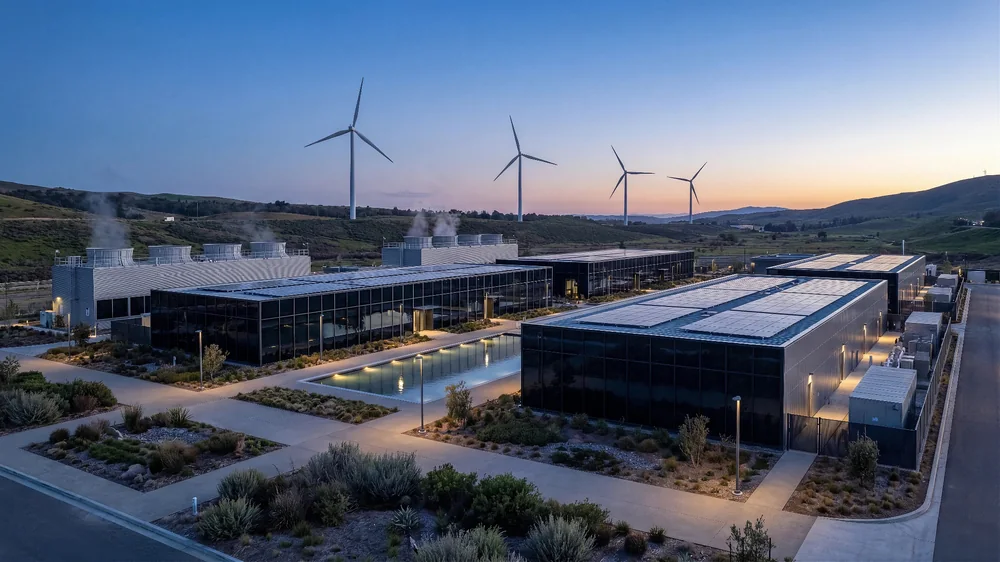
A sustainable data centre aims to reduce environmental impact across energy, carbon, water, equipment and waste while still meeting the availability and performance requirements of digital services. There is no single technology that makes a facility sustainable. Meaningful improvement requires measurement, efficient infrastructure, responsible energy sourcing, better IT utilisation and attention to the full equipment lifecycle.
Rapid growth in cloud computing and artificial intelligence makes this increasingly important because newer high-density workloads can place substantial pressure on electricity grids, cooling systems and water resources.
Why do data centres have an environmental impact?
Data centres require resources to:
- power servers, storage and networks
- remove heat
- operate UPS systems and power distribution
- run backup generators
- manufacture and replace IT equipment
- build and maintain facilities
- consume water in some cooling systems
The environmental impact therefore extends beyond the electricity shown on a utility bill.
What does data centre sustainability include?
A comprehensive sustainability programme can consider:
- energy efficiency
- greenhouse-gas emissions
- renewable energy
- water use
- equipment utilisation
- electronic waste
- refrigerants
- construction materials
- supply-chain emissions
- heat reuse
Improving one area should not be allowed to hide deterioration in another.
Start by measuring energy use
Organisations need reliable measurements before they can manage improvement.
Useful data includes:
- total facility energy
- IT equipment energy
- cooling energy
- UPS and distribution losses
- rack power
- renewable energy contribution
- carbon emissions
- water use
Baselines allow teams to compare performance over time and evaluate whether changes are delivering genuine improvement.
Use PUE, but do not rely on it alone
Power Usage Effectiveness compares total facility energy with IT equipment energy.
It is useful for understanding facility overhead, but it does not measure:
- server utilisation
- carbon intensity
- water consumption
- hardware lifecycle
- useful work produced
See What Is PUE? for the calculation and limitations.
Improve cooling efficiency
Cooling is one of the most important opportunities for facility improvement.
Measures can include:
- hot-aisle or cold-aisle containment
- blanking panels
- sealing unwanted floor openings
- optimising server inlet temperatures
- variable-speed fans and pumps
- efficient chillers
- economisation
- improved controls
- liquid cooling for high-density equipment
The aim is to remove the required heat with as little supporting energy as practical.
Read Data Centre Cooling Explained.
Avoid unnecessary overcooling
Older facilities were often operated at very low temperatures because operators believed colder always meant safer.
Modern equipment and industry guidance support wider operating ranges where appropriate.
Raising setpoints carefully within supported limits can reduce cooling demand without compromising reliability.
Increase IT equipment utilisation
A highly efficient building can still waste energy if it contains large numbers of underused servers.
Organisations can improve utilisation through:
- virtualisation
- workload consolidation
- containerisation
- removing zombie or unused servers
- rightsizing cloud and compute resources
- matching hardware to workload needs
Reducing unnecessary IT load also reduces the power, cooling and physical capacity required to support it.
Use more energy-efficient IT equipment
Modern servers can often perform more computing work per unit of energy than older generations.
Procurement decisions should consider:
- performance per watt
- expected utilisation
- power-management features
- hardware lifespan
- repairability
- reuse and recycling
Replacing equipment too frequently can create embodied-carbon and e-waste impacts, so lifecycle decisions need balance.
Use renewable and lower-carbon energy
Improving facility efficiency reduces the amount of energy required. Changing the source of that energy can reduce carbon impact further.
Options can include:
- on-site solar or other generation
- power-purchase agreements
- renewable-energy certificates
- direct procurement from lower-carbon sources
The quality and additionality of renewable-energy claims should be understood rather than relying on marketing labels alone.
What is carbon usage effectiveness?
CUE, or Carbon Usage Effectiveness, considers carbon emissions relative to IT energy consumption.
It complements PUE because two facilities with identical PUE values can have very different carbon impacts depending on their energy sources.
Manage water responsibly
Some cooling systems reduce electricity consumption by using water for evaporation.
That can create a trade-off between energy and water.
Operators can consider:
- local water scarcity
- cooling-system water consumption
- water quality
- recycled or non-potable water
- leak detection
- seasonal operating strategies
What is WUE?
Water Usage Effectiveness helps organisations measure facility water consumption in relation to IT energy.
Water should be considered alongside energy and carbon rather than treated as a separate issue.
Reduce electronic waste
Data centres replace large quantities of:
- servers
- storage devices
- network equipment
- batteries
- cables
- electronic components
A sustainable lifecycle can prioritise:
- reduce unnecessary purchases
- extend useful equipment life where appropriate
- reuse or redeploy equipment
- resell suitable assets
- recycle responsibly
Secure data destruction must be incorporated into reuse and disposal processes.
Consider embodied carbon
Embodied carbon refers to emissions associated with manufacturing, transporting and constructing equipment and facilities before operational energy is considered.
This means sustainability decisions should consider whether replacing a functioning asset early is genuinely better across the whole lifecycle.
Improve UPS and electrical efficiency
Power infrastructure itself consumes energy.
Operators can improve efficiency through:
- modern high-efficiency UPS systems
- appropriate loading
- efficient transformers
- reducing unnecessary conversion stages
- right-sizing infrastructure
- monitoring power factor and losses
Any efficiency change must still preserve required resilience.
Reuse waste heat
Servers turn electricity into heat, which is usually rejected to the environment.
Some facilities can recover heat for:
- district-heating networks
- nearby buildings
- industrial processes
- agriculture or greenhouses
Heat reuse depends heavily on location, temperature, infrastructure and whether there is a nearby customer for the heat.
Choose sites carefully
Site selection influences sustainability through:
- grid carbon intensity
- renewable-energy availability
- water scarcity
- outdoor climate
- network connectivity
- distance from users
- opportunities for heat reuse
A location that supports efficient cooling but relies on water in a water-stressed area can create a different environmental problem.
AI and sustainability
AI workloads are increasing demand for high-density GPU infrastructure.
This creates both challenges and opportunities:
- higher total power demand
- need for more grid capacity
- greater rack density
- increased liquid-cooling adoption
- potentially higher water use
- better compute utilisation through specialised hardware
Operators need to measure total resource use rather than judging efficiency from PUE alone.
Use automation and DCIM
Monitoring and control platforms can help identify inefficiency in real time.
Data Centre Infrastructure Management systems can track:
- power
- temperature
- capacity
- rack utilisation
- assets
- alarms
Machine learning can also support cooling optimisation and capacity forecasting where systems are designed and governed appropriately.
Set sustainability targets carefully
Useful targets should be:
- measurable
- based on reliable baselines
- linked to specific actions
- reviewed regularly
- transparent about boundaries
A target such as “become greener” is difficult to manage.
A stronger objective might specify reductions in facility energy, carbon intensity, water consumption or retired equipment sent to landfill over a defined period.
What standards support data centre sustainability?
Relevant frameworks and standards can include:
- ISO 14001 environmental management
- ISO 50001 energy management
- ISO/IEC 30134 data centre KPIs
- greenhouse-gas accounting standards
Organisations should use standards appropriate to their location, business and reporting obligations.
What can an existing data centre improve first?
A practical starting sequence is:
- measure current energy and water use
- identify idle IT equipment
- fix basic airflow problems
- review temperature setpoints
- analyse cooling-system efficiency
- review UPS and power losses
- improve IT utilisation
- assess renewable-energy options
- strengthen equipment reuse and recycling
- track performance over time
Many improvements do not require building an entirely new facility.
Common sustainability mistakes
- Focusing only on PUE. Carbon, water and IT utilisation matter too.
- Buying renewable certificates while ignoring waste. Energy efficiency should still be improved.
- Replacing equipment automatically. Lifecycle impacts need consideration.
- Ignoring water. Efficient cooling can still create local water pressure.
- Setting targets without measurement. Progress cannot be verified.
- Treating sustainability as a facilities-only issue. IT workload decisions have major impact.
Frequently asked questions
Can a data centre be carbon neutral?
Organisations may make carbon-neutral or net-zero claims under particular accounting approaches, but the quality of the claim depends on measurement boundaries, energy sourcing, operational emissions and treatment of residual emissions.
Are hyperscale data centres more efficient?
Many new large facilities achieve strong facility efficiency because they use modern infrastructure and operate at high load, though total energy consumption can still be enormous.
Does liquid cooling make a data centre greener?
It can improve thermal efficiency for high-density equipment, but the full impact depends on pumps, water, heat rejection, IT utilisation and facility design.
Why does server utilisation matter?
An idle server consumes energy without producing much useful work. Consolidating workloads can reduce both IT and facility energy requirements.
Can waste heat really be reused?
Yes, where there is a technically and economically suitable nearby heat demand and appropriate infrastructure.
What is the best sustainability metric?
No single metric captures everything. PUE, CUE, WUE, renewable energy, IT utilisation and lifecycle measures each provide different information.
Develop data centre sustainability expertise
The Certified Data Centre Environmental Sustainability Specialist (CDESS) is a two-day specialist course covering environmental management, greenhouse-gas emissions, PUE, CUE, WUE, energy savings, cooling, IT efficiency, water, waste and sustainable energy.
For broader infrastructure knowledge, explore the Certified Data Centre Professional (CDCP) and the full Data Centre training portfolio.
You may also find What Is a Data Centre?, What Is PUE? and Data Centre Cooling Explained useful.
Found this article useful? Add ExperTrain as a Preferred Source on Google to help surface more of our training guides, articles and learning resources.


.png)
