


What Is a Data Centre? A Beginner's Guide to Modern Data Centres
.svg)
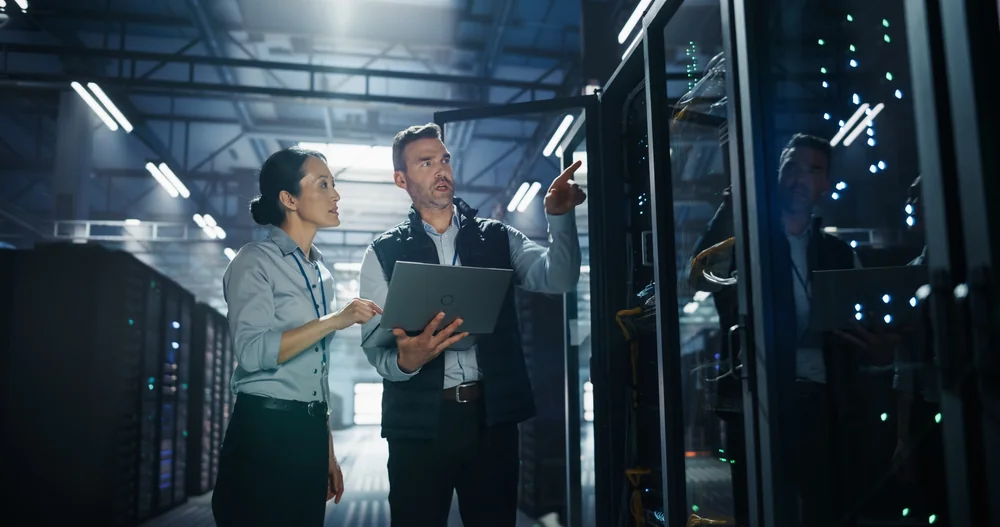
A data centre is a facility designed to house and operate the computing, storage and networking equipment that supports digital services. It provides much more than rows of servers. A modern data centre also needs resilient power, cooling, fire protection, physical security, monitoring, cabling and operational procedures to keep critical systems available.
Everyday activities such as using cloud software, streaming video, processing online payments, running AI applications and accessing business systems ultimately depend on physical computing infrastructure somewhere. Even public cloud services run in data centres.
What does a data centre contain?
A typical data centre brings together several infrastructure areas:
- servers and compute equipment
- data storage
- network switches and routers
- equipment racks
- copper and fibre cabling
- electrical distribution
- UPS systems and batteries
- backup generators
- cooling systems
- fire detection and suppression
- physical security
- environmental and infrastructure monitoring
The value of the facility comes from how these systems work together. Powerful servers are of little use if a power failure or cooling problem makes them unavailable.
Why do organisations need data centres?
Organisations depend on IT systems for activities such as:
- email and collaboration
- customer records
- financial transactions
- websites and applications
- analytics
- manufacturing systems
- healthcare information
- government services
- backup and disaster recovery
- artificial intelligence
Data centres provide controlled environments in which the infrastructure supporting these services can operate reliably and securely.
Are cloud services stored in data centres?
Yes. “Cloud” describes a way of delivering and consuming computing services, not the absence of physical infrastructure.
Cloud providers operate large data centre estates containing servers, storage and network equipment. Customers access logical resources without having to own or manage every underlying physical component.
See What Is Cloud Computing? for an introduction to IaaS, PaaS and SaaS.
What are the main types of data centre?
Enterprise data centre
An enterprise data centre is operated primarily for one organisation's own IT workloads. It may be located on the organisation's premises or in a dedicated facility.
Colocation data centre
A colocation provider supplies secure data centre space, power, cooling and connectivity to multiple customers. Customers may own and manage the IT equipment installed in their racks or cages.
Hyperscale data centre
Hyperscale facilities support very large cloud and internet platforms. They are designed to operate computing infrastructure at enormous scale using high levels of standardisation and automation.
Edge data centre
Edge facilities place computing resources closer to users, devices or sources of data where latency, local processing or connectivity requirements make that useful.
Modular data centre
Modular approaches use repeatable prefabricated components or facility modules that can be deployed and expanded in a more standardised way.
What is inside a server rack?
Data centre equipment is commonly mounted in standard racks.
A rack may contain:
- physical servers
- network switches
- storage systems
- power distribution units
- patch panels
- cable-management systems
Equipment size is commonly expressed in rack units, written as U. One rack unit is a standard vertical measurement used when planning equipment space.
How does data centre power work?
Data centres are designed to provide stable electrical power to IT equipment and to maintain service when components fail or utility power is interrupted.
A simplified power path can include:
- utility or grid power enters the facility
- transformers and switchgear distribute it
- UPS systems provide conditioned short-term backup power
- batteries bridge the gap while generators start
- generators can support the facility during longer utility outages
- PDUs and rack power systems deliver electricity to IT equipment
Actual designs vary according to facility size, resilience requirements and local infrastructure.
What is a UPS?
A Uninterruptible Power Supply provides temporary power and power-conditioning functions when the normal electricity supply is interrupted or unstable.
In a data centre, the UPS helps ensure that servers do not suddenly lose power while backup generation starts or other power arrangements take effect.
Why do data centres need generators?
Battery systems usually cannot support an entire facility indefinitely.
Backup generators can provide longer-duration emergency power when the utility supply fails. Fuel storage, maintenance, testing and generator redundancy are therefore important parts of facility operations.
Why is cooling so important?
Almost all electrical power consumed by computing equipment eventually becomes heat.
If that heat is not removed effectively, equipment temperatures can rise beyond safe operating conditions, causing reduced reliability or shutdowns.
Data centre cooling can use:
- computer-room air-conditioning systems
- chilled-water systems
- direct-expansion cooling
- hot-aisle or cold-aisle containment
- economisation or free-cooling approaches
- rear-door heat exchangers
- direct-to-chip liquid cooling
- immersion cooling in specialist designs
High-density AI and HPC systems are increasing interest in liquid-cooling technologies.
Read Data Centre Cooling Explained for more detail.
How does data centre networking work?
Servers need reliable network connectivity to users, other systems, storage and external networks.
Data centre networks can include:
- Ethernet switches
- routers
- firewalls
- load balancers
- fibre and copper cabling
- internet and private connectivity
- software-defined networking
Large facilities are designed with redundant paths so the failure of one switch, cable or uplink does not necessarily interrupt service.
For networking fundamentals, see Router vs Switch, What Is a VLAN? and What Is Subnetting?.
What is data centre redundancy?
Redundancy means providing additional components or capacity so that the failure or maintenance of one element does not automatically stop the service.
Examples can include:
- multiple power feeds
- redundant UPS modules
- multiple generators
- duplicate network paths
- multiple cooling units
- replicated servers and storage
Not every data centre uses the same redundancy architecture. Additional redundancy increases resilience but also cost, complexity and energy use.
What do N, N+1 and 2N mean?
These terms describe infrastructure capacity and redundancy at a simplified level.
N represents the capacity required to support the designed load.
N+1 adds one additional component or unit of capacity so the required load can still be supported if one component is unavailable.
2N provides a second complete capacity path in suitable designs.
Real facility topology is more nuanced, but these terms are widely used when discussing power and cooling resilience.
What are data centre tiers or ratings?
Different standards and organisations use rating systems to describe facility resilience and topology.
Terms such as Tier I to Tier IV are strongly associated with Uptime Institute's Tier Standard, while other standards use different rating terminology.
It is important not to treat every data centre using words such as “Tier 3” as formally certified unless the relevant certification has actually been awarded.
How are data centres physically secured?
Physical security can include multiple layers such as:
- site perimeter controls
- security staff
- CCTV
- identity checks
- access-control systems
- mantraps
- locked racks and cages
- visitor procedures
- audit logs
Access should be limited according to role and business need.
How are data centres protected from fire?
Fire protection can combine:
- early smoke detection
- zoned alarms
- portable extinguishers
- water-based or gaseous suppression systems
- fire-rated construction
- operational procedures
The design must satisfy relevant local safety requirements while protecting critical equipment and people.
What is DCIM?
Data Centre Infrastructure Management software helps operators monitor and manage facility and IT infrastructure information.
DCIM systems can support areas such as:
- power capacity
- rack occupancy
- environmental readings
- asset management
- alarms
- energy efficiency
- capacity planning
Facilities may also use building-management systems and environmental-management systems alongside DCIM.
How is data centre efficiency measured?
One widely used facility metric is Power Usage Effectiveness, or PUE.
PUE compares total data centre energy with the energy used by IT equipment. A lower value indicates that a smaller proportion of energy is being consumed by supporting facility infrastructure.
PUE is useful but does not measure whether the servers themselves are doing useful work efficiently.
See What Is PUE?.
Why are AI workloads changing data centres?
AI training and inference can require large numbers of high-performance accelerators packed into dense computing clusters.
This affects:
- rack power density
- electrical distribution
- cooling
- network bandwidth
- capacity planning
- water and energy requirements
As rack densities rise, facilities may need liquid cooling and different electrical architectures compared with traditional enterprise server environments.
Are data centres bad for the environment?
Data centres consume electricity, water in some cooling designs, materials and land. Their environmental impact depends on factors including energy source, facility efficiency, IT utilisation, cooling technology and hardware lifecycle.
Operators can reduce impact through efficiency improvements, renewable energy procurement, better server utilisation, water management, waste reduction and improved equipment lifecycle decisions.
Read How Can Data Centres Become More Sustainable?.
What jobs exist in data centres?
Data centre roles include:
- data centre technician
- facilities engineer
- network engineer
- operations specialist
- critical-environment engineer
- data centre manager
- security specialist
- design consultant
- sustainability specialist
- migration specialist
Different roles require different combinations of IT, networking, electrical, mechanical and operational knowledge.
See What Qualifications Do Data Centre Engineers Need?.
Frequently asked questions
Is a data centre just a room full of servers?
No. Servers are only one part of the environment. Reliable data centres also require power, cooling, networking, security, fire protection, monitoring and disciplined operations.
Where is cloud data actually stored?
Cloud data and applications are hosted on physical infrastructure in provider-operated data centres, subject to the architecture, region and service selected by the customer.
Do small companies need their own data centre?
Often not. Small organisations commonly use SaaS, public cloud and colocation services rather than building dedicated facilities.
Can a data centre run without people?
Automation and remote management reduce manual activity, but facilities still require skilled people for design, maintenance, incident response, security, capacity management and governance.
Why are data centres built in particular locations?
Site selection can consider power availability, connectivity, climate, flood and seismic risks, land, water, planning rules, security and proximity to users.
Are data centres the same as server rooms?
A server room can contain IT equipment but generally lacks the scale, resilience and specialist facility infrastructure associated with a purpose-designed data centre.
Learn data centre fundamentals with ExperTrain
The Data Centre Foundation Certificate (DCFC) provides a two-day introduction to data centre facilities, power, cooling, networking, security, fire protection and monitoring.
Those wanting a deeper professional-level foundation can progress to the Certified Data Centre Professional (CDCP).
Explore the full Data Centre training portfolio and Data Centre Certification pathways.
Found this article useful? Add ExperTrain as a Preferred Source on Google to help surface more of our training guides, articles and learning resources.


.png)
