


Which Microsoft Certification Should I Take?
.svg)
The best Microsoft certification depends on the job you want to do, not simply on which exam is most popular. If you are new to Microsoft cloud technology, start with a Fundamentals certification that matches your area of interest. If you already have practical experience, choose a role-based certification aligned to your day-to-day responsibilities or your target job.
For example, AZ-900 is a sensible starting point for Azure, PL-900 for Power Platform, DP-900 for Azure data, SC-900 for security, compliance and identity, and AI-901 for Azure AI. From there, you can move towards administrator, data analyst, solutions architect, security, AI or other specialist roles.
Microsoft changes its certification portfolio regularly, so it is also important to check that the certification you are planning to take is still active. Several well-known credentials have recently retired or are approaching retirement, including AI-900, AI-102, AZ-204 and AZ-500.
Microsoft certifications at a glance
Microsoft Credentials currently include both Microsoft Certifications and Microsoft Applied Skills. Certifications are broader credentials based on job roles and are typically earned through a proctored exam. Applied Skills are shorter, scenario-based credentials designed to validate a particular practical skill.
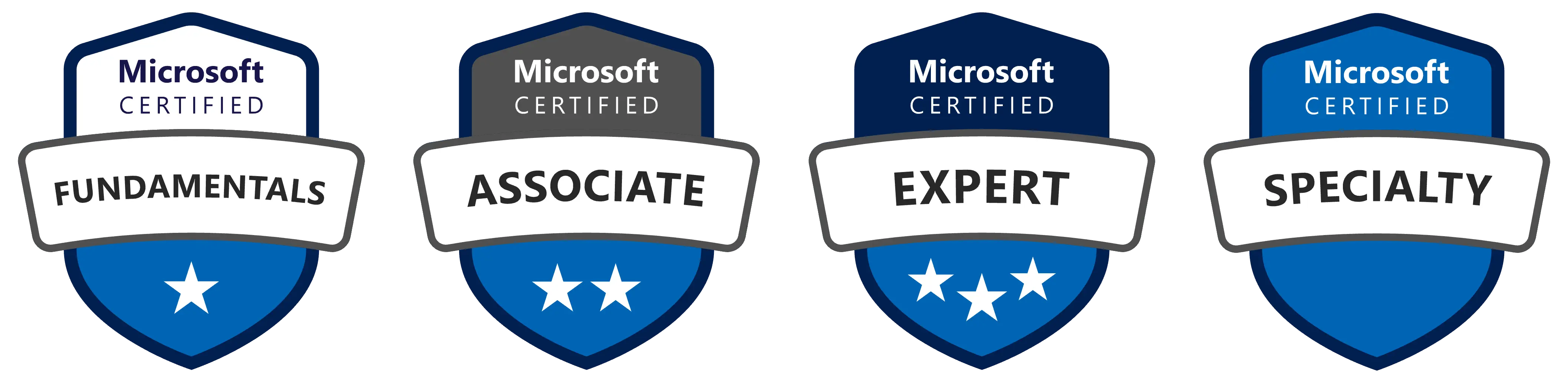
For someone building a long-term career pathway, the certification structure generally progresses through:
- Fundamentals for introductory knowledge.
- Associate for practical role-based skills.
- Expert for advanced roles that may require another certification first.
- Specialty for focused technical areas.
You do not need to collect certifications from every level. A person with relevant experience can move directly into an Associate-level certification if the fundamentals material is already familiar.
Which Microsoft certification is best for beginners?
If you are completely new to Microsoft cloud technologies, a Fundamentals certification is usually the clearest starting point. The most useful option depends on the subject you want to explore.
AZ-900: Microsoft Azure Fundamentals
Choose AZ-900 if you want a broad introduction to Microsoft Azure and cloud computing. It covers cloud concepts, Azure architecture and services, security, identity, governance, management and cost considerations.
It is particularly useful for people who work with Azure but are not yet Azure administrators or engineers, as well as people considering a move into cloud technology.
ExperTrain's Introduction to Cloud Infrastructure (AZ-900) course provides a one-day foundation and supports preparation for the AZ-900 exam.
AI-901: Microsoft Azure AI Fundamentals
Choose AI-901 if you want a current introduction to artificial intelligence concepts and the Azure services used to implement AI solutions. The exam covers AI concepts and capabilities together with practical implementation using Microsoft Foundry.
AI-901 replaced the retired AI-900 exam but continues to lead to the Microsoft Certified: Azure AI Fundamentals certification.
ExperTrain's Introduction to AI in Azure (AI-901) course provides a one-day instructor-led route covering generative AI and agents, natural language processing, speech, computer vision, information extraction and Microsoft Foundry.
DP-900: Microsoft Azure Data Fundamentals
Choose DP-900 if you are more interested in data than general cloud administration. It introduces relational and non-relational data, analytics workloads and the Azure services used to store, process and analyse data.
It is a useful starting point for future data analysts, database professionals, data engineers and technical professionals who work alongside data teams.
ExperTrain's Introduction to Microsoft Azure Data (DP-900) course covers these fundamentals.
PL-900: Microsoft Power Platform Fundamentals
Choose PL-900 if you want to understand low-code business solutions using Power Apps, Power Automate, Power BI, Power Pages and Dataverse.
This route is particularly suitable for business users, analysts, process-improvement professionals and people who want to automate work or create applications without becoming traditional software developers.
ExperTrain's Introduction to Microsoft Power Platform (PL-900) course provides a broad introduction to the platform.
SC-900: Microsoft Security, Compliance, and Identity Fundamentals
Choose SC-900 if your interest is cybersecurity, identity, compliance or information protection. It introduces Microsoft Entra ID, Microsoft security services, Microsoft Sentinel, Defender XDR and Microsoft Purview.
ExperTrain's Introduction to Microsoft Security, Compliance, and Identity (SC-900) course is a useful starting point before progressing into a more specialised security role.
Which Microsoft certification should I take for Azure administration?
If you manage or expect to manage Microsoft Azure environments, Microsoft Certified: Azure Administrator Associate is one of the clearest role-based routes.
The AZ-104 exam covers areas including Azure identities and governance, storage, compute resources, virtual networking, monitoring and backup. Microsoft expects candidates to be familiar with operating systems, networking, servers and virtualisation, as well as tools such as PowerShell, Azure CLI and the Azure portal.
ExperTrain's Microsoft Azure Administrator (AZ-104) course is suitable for IT professionals moving from general infrastructure into Azure administration.
A typical progression is:
- AZ-900 if you need cloud fundamentals.
- Gain hands-on Azure experience.
- AZ-104 for administrator skills.
- Progress into architecture, networking, security or another specialist area.
Which Microsoft certification should I take for cloud architecture?
If your goal is to design Azure solutions rather than primarily administer them, the Microsoft Certified: Azure Solutions Architect Expert path is more appropriate.
The current route requires the Azure Administrator Associate certification as a prerequisite and includes the AZ-305 exam. AZ-305 focuses on designing identity, governance, monitoring, data storage, business continuity and infrastructure solutions.
This is not usually the best first Microsoft certification. Microsoft expects solutions architect candidates to have advanced IT operations knowledge across networking, virtualisation, identity, security, business continuity, disaster recovery, data platforms and governance.
ExperTrain's Design Microsoft Azure Infrastructure Solutions (AZ-305) course supports this advanced route.
A sensible architecture progression is:
- Azure fundamentals if required.
- Azure administration experience and AZ-104.
- Broader experience across networking, security, resilience and governance.
- AZ-305 and the Azure Solutions Architect Expert path.
Which Microsoft certification should I take for Power BI?
If you use Power BI professionally, the most directly relevant Microsoft certification is Microsoft Certified: Power BI Data Analyst Associate, based on the PL-300 exam.
The certification is aimed at people who prepare, model, visualise and analyse data using Power BI. Microsoft also expects candidates to be proficient with Power Query and DAX and to understand how to manage and secure Power BI content.
ExperTrain's Design and Manage Analytics Solutions using Power BI (PL-300) course covers the complete workflow from data preparation and modelling through report design, workspaces, dashboards and security.
If you are new to Power BI, it can be better to build practical skills before taking PL-300. ExperTrain also offers Power BI Desktop Introduction, Power BI Desktop Intermediate and Power BI Desktop Advanced courses.
You may also find our Power BI vs Excel guide useful if you are deciding whether Power BI is the right direction for you.
Which Microsoft certification should I take for cybersecurity?
Microsoft security certifications cover several different roles, so it is important to choose the area you actually want to work in.
Security operations: SC-200
Microsoft Certified: Security Operations Analyst Associate is appropriate for people who investigate, respond to and hunt for threats. The SC-200 exam covers Microsoft Sentinel, Microsoft Defender XDR, Microsoft Defender for Cloud, security incidents and threat hunting.
ExperTrain's Defend Against Cyberthreats with Microsoft's Security Operations Platform (SC-200) course follows this route.
Identity and access: SC-300
Microsoft Certified: Identity and Access Administrator Associate is more appropriate if your responsibilities centre on Microsoft Entra ID, authentication, Conditional Access, single sign-on, identity governance and privileged access.
ExperTrain's Microsoft Identity and Access Administrator (SC-300) course supports this pathway.
Information protection and governance: SC-401
Microsoft Certified: Information Security Administrator Associate is aimed at professionals protecting sensitive information using Microsoft Purview. It covers information protection, data loss prevention, retention, insider risk and the protection of data used by AI services.
ExperTrain's Protect Sensitive Information with Microsoft Purview in the AI Era (SC-401) course develops these skills.
Cloud and AI security: SC-500
Microsoft is retiring the Azure Security Engineer Associate certification and AZ-500 exam on 31 August 2026. Its newer security engineering route is Microsoft Certified: Cloud and AI Security Engineer Associate, based on SC-500.
SC-500 expands the role beyond traditional Azure security to include cloud, hybrid and AI-enabled environments. It covers identity, Key Vault, governance, storage, databases, networking, compute, AI security and security posture management.
If you are starting a Microsoft security certification now, this newer route is more future-facing than beginning an AZ-500 pathway immediately before its retirement.
Which Microsoft certification should I take for Microsoft 365?
For endpoint administration, Microsoft 365 Certified: Endpoint Administrator Associate is a strong current role-based option. It is based on MD-102 and covers deployment, Microsoft Intune, device management, application management, endpoint security and modern management.
ExperTrain's Microsoft 365 Endpoint Administrator (MD-102) course is suitable for IT professionals responsible for Windows and other managed devices in Microsoft 365 environments.
Be more cautious when planning around older Microsoft 365 certification routes. The Microsoft 365 Administrator Expert certification and MS-102 exam are scheduled to retire in October 2026. If that was your intended goal, check Microsoft's current certification pages before committing to a longer study path.
Which Microsoft certification should I take for AI?
Microsoft's AI certification portfolio changed significantly during 2026. The former AI-900 exam retired on 30 June 2026 and was replaced by AI-901: Microsoft Azure AI Fundamentals.
AI-901 continues to lead to the Microsoft Certified: Azure AI Fundamentals certification, but the newer exam places greater emphasis on practical AI solution development using Microsoft Foundry. It covers AI concepts and capabilities as well as implementing generative AI, agents, text analysis, speech, computer vision and information extraction solutions.
ExperTrain's Introduction to AI in Azure (AI-901) course is the current fundamentals-level starting point.
For learners ready to progress beyond fundamentals, the AI-103 exam supports the Azure AI Apps and Agents Developer Associate route. It is aimed at Azure AI engineers who build, manage and deploy generative AI applications, agents, computer vision, text analysis and information extraction solutions using Microsoft Foundry.
ExperTrain's Develop AI Apps and Agents on Azure (AI-103) course covers this more advanced developer pathway.
Should I take a Fundamentals certification first?
Not necessarily. Fundamentals certifications are valuable when you are new to a subject, but experienced professionals do not need to complete every lower-level exam before progressing.
Consider taking a Fundamentals certification if:
- You are new to the technology.
- You are changing career.
- You work alongside technical teams but do not yet administer the platform.
- You want a structured introduction before choosing a specialist role.
You may be able to skip it if:
- You already use the technology regularly.
- You meet the knowledge expectations for the role-based exam.
- Your objective is a specific job role and the Fundamentals certification is not a prerequisite.
Which Microsoft certification is easiest?
Fundamentals certifications are generally more accessible than Associate or Expert certifications because they validate broad introductory understanding rather than deep hands-on job skills.
However, the easiest exam is not necessarily the most useful exam. If your job requires Power BI, for example, PL-300 may provide more career value than an unrelated Fundamentals certification even though it requires significantly more preparation.
Which Microsoft certification is best for getting a job?
There is no single Microsoft certification that guarantees better employment prospects. The strongest choice is the one that closely matches the role employers are recruiting for.
A useful way to decide is to review vacancies for your target role and note which technologies and certifications appear repeatedly. Then choose a certification that strengthens skills you can demonstrate practically.
For example:
- Cloud administrator: AZ-104.
- Azure solutions architect: AZ-104 followed by AZ-305.
- Power BI data analyst: PL-300.
- Security operations analyst: SC-200.
- Identity administrator: SC-300.
- Information security administrator: SC-401.
- Cloud and AI security engineer: SC-500.
- Endpoint administrator: MD-102.
- Azure AI fundamentals: AI-901.
- Azure AI apps and agents developer: AI-103.
Do Microsoft certifications expire?
Microsoft Fundamentals certifications do not currently require annual renewal. Eligible Associate, Expert and Specialty certifications normally expire after 12 months unless renewed.
Microsoft allows eligible certifications to be renewed at no cost through an online renewal assessment on Microsoft Learn. Certification and renewal policies can change, particularly when exams are retired, so always check the current Microsoft credential page before planning your study schedule.
How to choose your Microsoft certification
If you are unsure where to start, use this simple process:
- Choose the role first. Decide whether you want to work in cloud administration, architecture, data, Power BI, security, Microsoft 365, AI or another area.
- Assess your current experience. Beginners may benefit from Fundamentals; experienced professionals may be ready for Associate level.
- Check the certification status. Confirm that the exam and certification are active and not close to retirement.
- Review the official skills measured. Compare them with your current knowledge and daily work.
- Build practical experience. Use labs, real projects and hands-on administration alongside exam preparation.
- Plan the next step. Choose a pathway where each course and certification builds naturally on the one before it.
Example Microsoft certification pathways
Azure administrator: AZ-900 → practical Azure experience → AZ-104.
Azure solutions architect: AZ-900 if required → AZ-104 → broader architecture experience → AZ-305.
Power BI data analyst: Power BI Desktop skills → data modelling and DAX → PL-300.
Microsoft security: SC-900 → choose SC-200, SC-300, SC-401 or SC-500 according to your role.
Azure AI: AI-901 for fundamentals → practical Azure AI experience → AI-103 for AI apps and agents development.
Endpoint administrator: Microsoft 365 and Windows administration experience → MD-102.
Frequently asked questions
Can I take AZ-104 without AZ-900?
Yes. AZ-900 is not a prerequisite for Azure Administrator Associate. If you already understand cloud and Azure fundamentals, you can progress directly to AZ-104.
Should I take AZ-900 or PL-900?
Choose AZ-900 for Microsoft Azure and cloud infrastructure. Choose PL-900 if you are interested in low-code applications, automation, Power BI and the Power Platform.
Should I take DP-900 or PL-300?
DP-900 is a fundamentals certification covering Azure data concepts. PL-300 is an intermediate role-based certification specifically for Power BI data analysts. Beginners to data may start with DP-900, while regular Power BI users may be better suited to PL-300.
Is AZ-500 still worth taking?
AZ-500 and the Azure Security Engineer Associate certification retire on 31 August 2026. Someone starting a new security pathway should normally investigate the newer SC-500 Cloud and AI Security Engineer Associate certification instead.
Has AI-900 been replaced?
Yes. The AI-900 exam retired on 30 June 2026 and was replaced by AI-901: Microsoft Azure AI Fundamentals. Both exams lead to the Microsoft Certified: Azure AI Fundamentals certification, but AI-901 reflects Microsoft's newer AI and Microsoft Foundry skills.
Develop your Microsoft skills with ExperTrain
ExperTrain offers instructor-led Microsoft training across Azure, Power BI, Microsoft 365, Power Platform, security, data and artificial intelligence. Courses range from introductory fundamentals through administrator, analyst, architect and specialist pathways.
If you are unsure which route matches your experience, contact ExperTrain with your current role and career objectives and we can help you identify an appropriate starting point.
You may also find our AWS vs Azure Certification guide useful if you are still deciding which cloud platform to focus on.
Further reading
- Microsoft Credentials
- Microsoft Certified: Fundamentals
- Microsoft Exam AI-901: Azure AI Fundamentals
- Microsoft Certified: Azure Administrator Associate
- Microsoft Certified: Azure Solutions Architect Expert
- Microsoft Certified: Power BI Data Analyst Associate
- Microsoft Certified: Cloud and AI Security Engineer Associate
- Microsoft credential retirement information
AI certification update: AI-900 has retired. Start with the current Introduction to AI in Azure (AI-901) course for Microsoft Azure AI Fundamentals.
Found this article useful? Add ExperTrain as a Preferred Source on Google to help surface more of our training guides, articles and learning resources.


.png)
